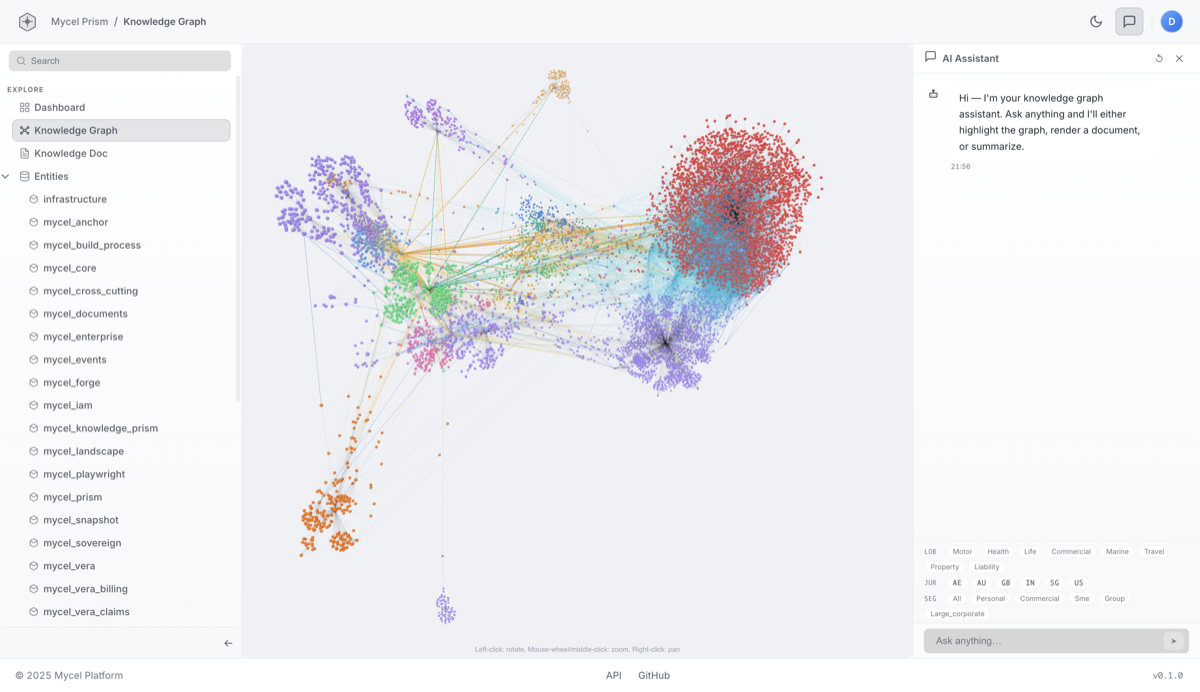
Prism turns organizational knowledge into a typed, traversable graph. LLMs navigate it in milliseconds and return correct output — not because they got smarter, but because they finally have the knowledge they need.
Prism ingests Forge output directly — documents processed through Forge pipelines become typed nodes and edges in the graph, not summaries.
Query
What are subrogation rights if the
third party is uninsured in a
cross-emirate incident?
Prism
Based on UAE Civil Transactions Law and Motor Vehicle Insurance regulations:
→ Subrogation applies under Art. 1034
→ Cross-emirate: CBUAE rules apply
→ Uninsured: Motor Vehicles Act §146
Every node has a kind. Every edge has a predicate. The graph knows what it stores and how pieces relate — making traversal semantic, not statistical.
"What does this module transitively depend on?" is a single graph traversal. No application code. No BFS loops. The graph handles transitive closure natively.
Every document added becomes nodes and edges. An invariants doc: eleven new nodes. A claims guide: two thousand sections. The graph grows. It never shrinks.
AI is intelligent but ignorant.
Architecture decisions in design docs. Domain rules in knowledge bases. Regulatory constraints in compliance guides. Entity relationships in the heads of people who may not be here next year.
No amount of model intelligence compensates for missing knowledge.
A genius with no textbook still fails the exam.
"What does this module depend on?"
Graph traversal: follow DEPENDS_ON edges to arbitrary depth. RAG finds the most similar paragraph.
"Is this claim covered under this policy?"
Eight-step determination sequence across multiple knowledge nodes. RAG returns one paragraph.
"What invariants govern the service layer?"
Follow GOVERNED_BY edges. The graph knows these explicitly. A vector store can only guess.
Indian health and motor insurance. The hardest domain we could find.
763 domain entities across nine modules. 31,595 lines of claims processing knowledge. IRDAI regulatory mandates, Motor Vehicles Act constraints, eight-step coverage determination sequences, four-level adjudication authority matrices.
Eleven build invariants encoded. Every LLM interaction from this point forward respects them. No new developer violates them unknowingly.
Nine module designs, dependencies, integration contracts. LLM scaffolds new modules that correctly integrate with existing ones.
Domain rules encoded. LLM generates domain-correct business logic, not just structurally correct code.
3,000+ nodes. The LLM inherits six months of accumulated organizational intelligence — instantly, completely, precisely.