cogniworks
Control plane

Design it.
Operate it.
Evolve it.

Anchor maintains a live, typed, traversable model of every service, every dependency, every configuration, every integration, and every constraint in your system — and uses that model to detect issues before they form, compute the blast radius of any change before it lands, and route problems to resolution without waiting for a human to wake up, log in, and spend forty minutes remembering how the system works.

49 modulesk3s nativelive topologyMCP · WEB · MOBILE
anchor · operate
DesignOperateEvolve

Network topology

Platform

mycel_coremycel_iammycel_enterprisemycel_sovereign

Observability

prometheusgrafanatempoloki
D

Design

Module registry. Every module declares its SERVICE, MCP, WEB, and MOBILE targets. 49 modules. One source of truth.

O

Operate

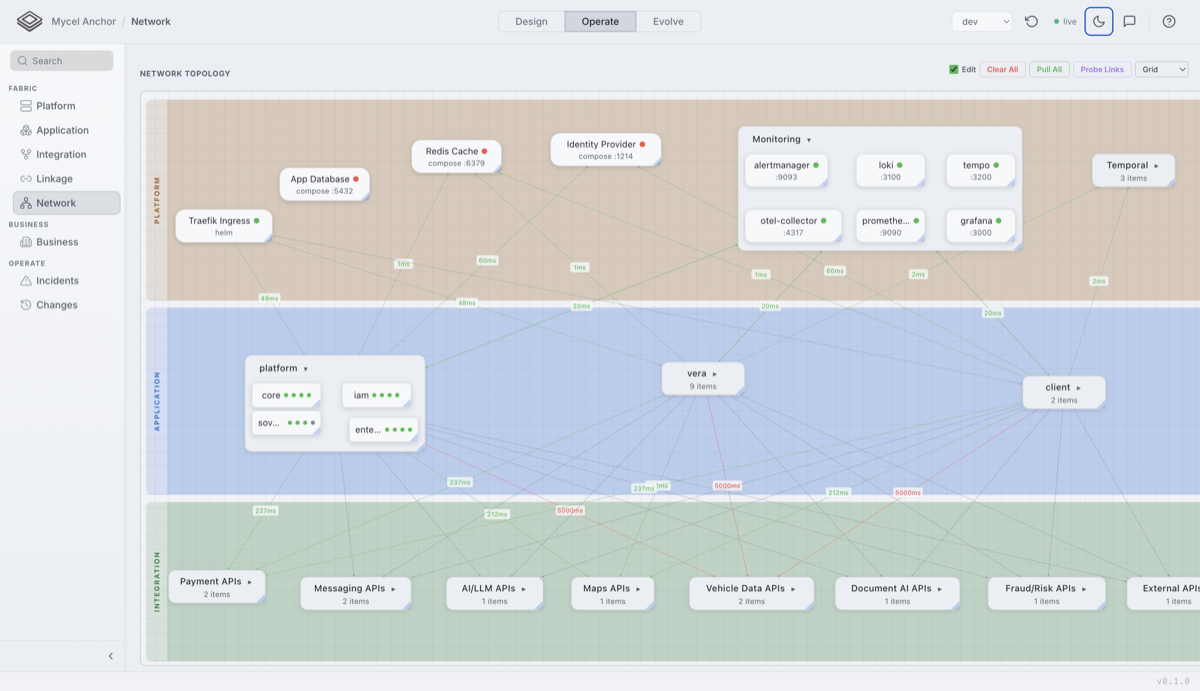
Live network topology across Platform, Application, and Integration layers. Real-time latency between every node.

E

Evolve

Deploy, undeploy, restart — per service, per environment, per namespace. One-click with live log streaming.

The problem

Complex systems cannot think about themselves.

They generate signals. Terabytes of logs, metrics, traces, events — every second, from every layer. And then they wait. For a human to notice. Interpret. Decide. Act. Every year, systems grow more complex. Human teams do not grow proportionally. The gap widens.

What Anchor is

Not monitoring.Anchor understands.

Monitoring watches. Anchor maintains a live model of what is actually running — not what was documented, not what someone drew on a whiteboard.

Not alerting.Anchor reasons.

Alerting notifies. Anchor watches relationships between signals across the dependency graph — the patterns that form before a crisis.

Not automation.Anchor navigates consequences.

Automation executes scripts. Anchor computes blast radius, routes known patterns to resolution, and surfaces consequential decisions for human confirmation.

Three capabilities that don't exist together anywhere

Live system self-awareness

Anchor knows what's running — not what was documented, not what someone drew on a whiteboard, but what is actually deployed right now. It doesn't observe the truth from outside. It is the source of truth.

Issue formation detection

Every incident has a prelude. Latency creeps before it spikes. Configuration drifts before it breaks. Anchor watches the relationships between signals across the dependency graph — the patterns that form before a crisis.

Resolution intelligence

For known patterns: Anchor acts — configuration corrected, services restarted, traffic rerouted. For consequential decisions: Anchor surfaces the situation and waits for human confirmation. Human attention reserved for what matters.

What changes

The 3am page disappears.

Not because alerts are suppressed — because the issue was detected and resolved autonomously hours earlier.

Operations becomes strategic.

The team's job is not to fix things. It is to govern the policies by which things fix themselves.

Change becomes safe.

Blast radius is computed from the live dependency graph, not guessed from documentation.

Knowledge stops leaving.

Platform intelligence stops living in the heads of three senior engineers and becomes traversable by everyone.